The Booth
and the Thirty Years Nobody Priced In
She handled everything the new system has no category for.
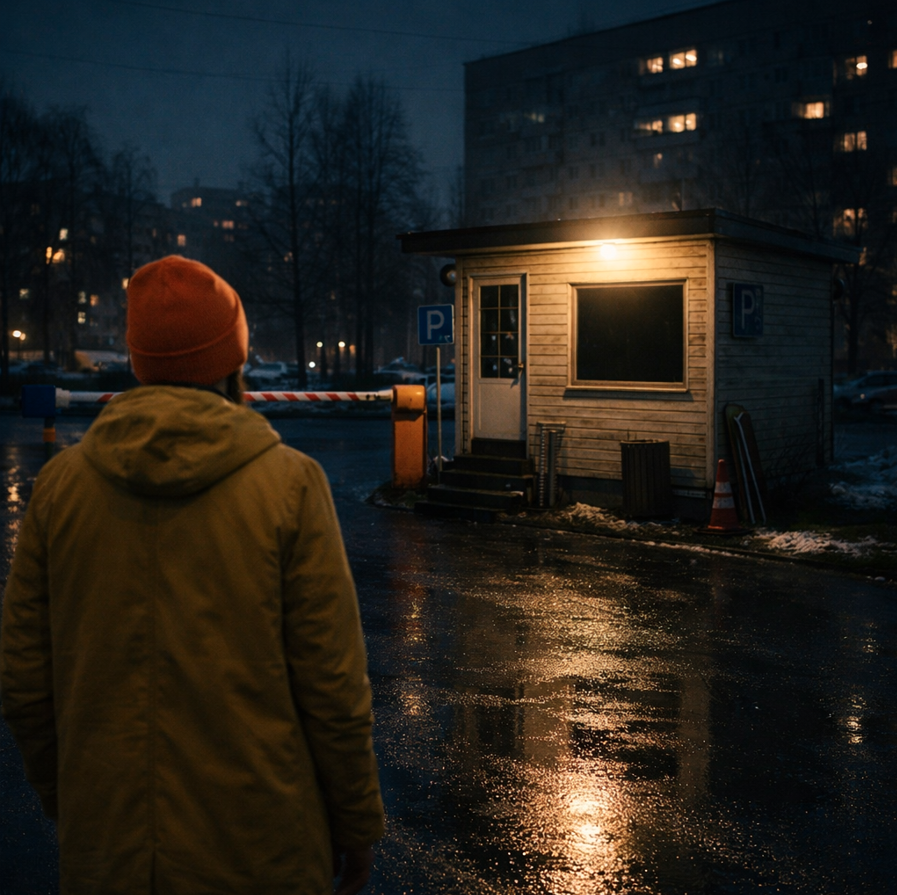
It was a Friday evening, late.
I drove into the neighborhood the way I always do when the clock is past ten: already knowing the free parking near our building would be full, already planning for the backup. The paid lot around the corner. The booth with the light on.
I had used that parking maybe once or twice a month for fourteen years. Never bought a monthly pass. Just pulled up, said hello, left three euros, got a spot for the night.
The woman working that evening was Lena.
I had known her since 2012, when we first moved to the building. Not well. But the way you know someone who is always in the same place, always dependable, always finds a solution when you need one.
That evening, when I asked if I could leave the car overnight, she said something I was not expecting.
This is probably the last time.
The owner had told her that morning. Sunday at noon, she was to hand over the key to the booth. Her contract was ending. The lot was going digital: cameras, automatic barriers. No more cash. No more booth. No more Lena.
She had worked there for over thirty years.
I did not leave. We stood by the booth for maybe fifteen, maybe twenty minutes. She talked about watching the neighborhood get built. She talked about the families she had seen arrive and leave. About the small things she handled over the years: a scratch on someone's car, a fuse that needed replacing, people who forgot to pay and came back the next day. She said hello and goodbye to people every single day for three decades. She felt like part of the place.
I am in the IT industry. I understood the business case immediately. The system practically sells itself to any owner running the numbers.
And standing there, I held both things at once.
The logic was correct. And something real was ending.
What Lena actually provided was never on any cost line.
Yes, she collected three euros. But she also remembered which regulars came in late on Fridays. She handled the situations the new system has no category for.
Once in fourteen years, she could not find me a spot. Once.
That is not a metric anyone measured. It was just a thing that worked, invisibly, until it stopped.
The new system took over the transaction. The rest did not transfer anywhere. It simply disappeared.
A few weeks later, my wife noticed something.
An old man now comes to clean the lot. Sweeps it, removes leaves, checks the surface. She does not remember anyone doing that before. Lena used to handle it herself, as part of whatever the job required.
So the labor did not vanish. It redistributed. One older person lost a role. Another older person gained one. Nobody planned this. It is just what the system produced.
The owner of that parking lot made a rational decision. I do not doubt that. The cameras work. The barriers work.
What does not work is the thing I needed late one Thursday evening, when the lot was full and the barrier was closed and there was no one to ask.
I drove around. Ended up on the expensive lot nearby. Paid for the night. Left a few minutes past eight in the morning and paid again, because the system had already started a new billing cycle.
Every time this happens now, I think about Lena.
Not with sentimentality. With precision.
She was solving a problem that was never written down anywhere. And the system that replaced her does not know that problem exists.
Digital transformation is usually sold as replacement.
Same function, lower cost, higher reliability.
But the functions that get replaced are the ones that were measured. The ones that were visible in the ledger.
What does not get replaced is institutional memory. The workaround someone developed over thirty years. The judgment call made at eleven on a Friday. The thing that just worked because a person was paying attention.
Those functions do not appear in the presentation.
They appear afterward, in the gap.
The booth is still there. A DVR unit now lives where she used to sit.
My apartment windows face the lot. I see it every day.
Nobody says hello.