The Chimney Was Open
Everything was done correctly. The system still was not ready.
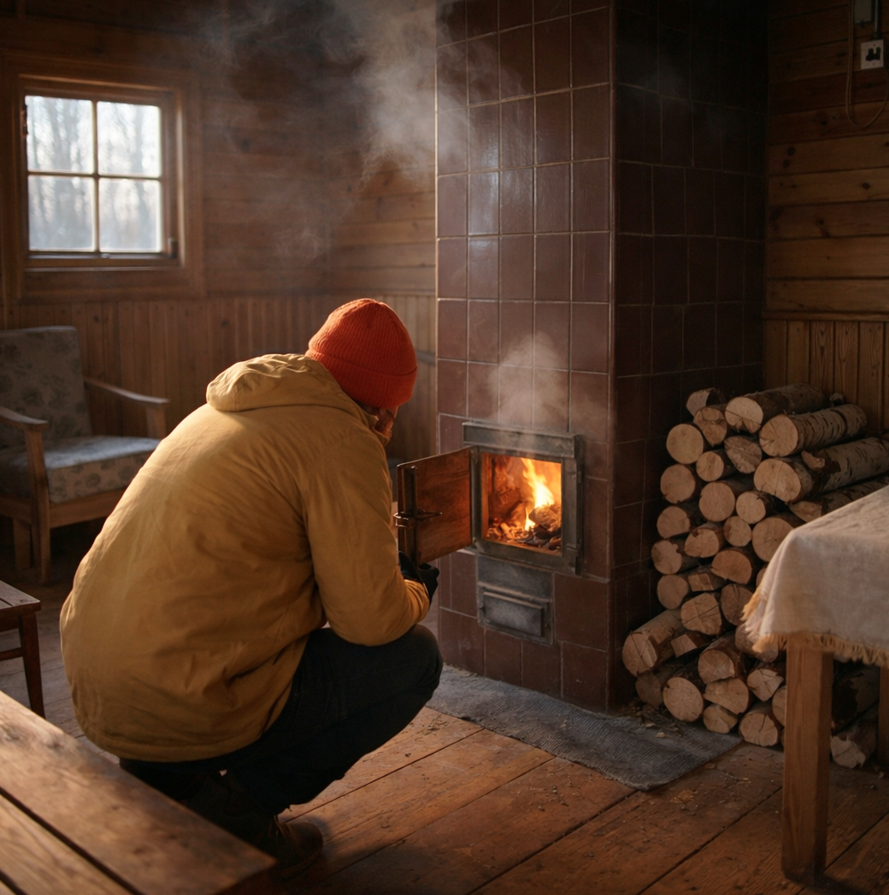
Last weekend at the cottage, my wife lit the stove.
Within minutes, smoke was filling the room.
The chimney was open. We checked. We opened it wider. Closed it slightly. Opened it again. The smoke kept coming in.
Everything looked correct. Nothing was working.
I pulled out my phone and asked ChatGPT why smoke comes back into the room from a stove.
The answer came quickly. One of the first reasons listed: a cold air column in the chimney. When a stove sits unused, cold air settles inside. It becomes a physical block. A small fire cannot push through it.
The chimney being open had nothing to do with it.
I remembered something my father had shown me once.
I cleared the stove completely. Pulled out the unburned wood, the ash, everything. Then I did not try to light the stove again. Not yet.
I made a small fire from sticks and paper. Just enough to warm the channel above it.
Then I placed dry birch logs around it.
Five minutes later, the pull had reversed. Smoke was going where it was supposed to go.
My wife was happy. The room cleared.
Later I kept thinking about that cold air column.
Not the one in the chimney. The other kind.
In projects and organizations, I have seen the same pattern many times.
The checklist is done. The procedure is followed. The right people are in the room. Formally, everything is open.
And still, the smoke goes the wrong way.
The energy that was supposed to move the process forward comes back inside instead. Into tension. Into extra meetings. Into frustration. Into manual workarounds. Into long explanations of why something that should be simple is not moving.
From the outside it can look like the system is working. It is producing heat, after all.
It is just not producing pull.
The invisible cold air column in organizations takes many shapes.
Sometimes it is simply that people do not understand what is expected of them. Not because they are unwilling. Because they have never seen it done. What feels obvious to an experienced person is genuinely foreign to someone without that reference. They are not resisting. They are lost.
Sometimes it is more deliberate. Someone carries a grievance. Someone is dealing with something outside of work: health, family, a situation that has nothing to do with the project but takes up all available space. They are present on paper but not available in any useful sense.
Sometimes it is simpler than that. Carelessness. No real stake in the outcome. The absence of any ownership over the result.
These are not exotic problems.
They sit in almost every team, in some proportion, at almost any given time.
The column is always somewhere nearby.
What I learned from the stove is not complicated.
More fire does not help when the channel is blocked.
Putting more wood into a cold stove makes more smoke, not better pull. The fix was not more energy. The fix was sequence: clear the channel, build a small stable fire, let the system warm up, then add the real logs.
In organizations, the instinct is often the opposite. When something is not working, the response is to push harder. More resources. More pressure. More process. More meetings about the process.
But if the column is still there, none of it moves.
I am a person who trusts checklists. I trust correct steps. I trust procedure.
And I have learned, slowly, that a clean checklist does not guarantee working pull.
The invisible condition still has to be met.
The chimney can be fully open. The column can still be there.