The Lightbulb Stage
and the Layer We Keep Misreading
Chat is the first obvious trick of a technology that has not shown its real shape yet.
The meeting had just ended.
I was still at my desk in Riga. Early April. Sunny spring day. Through the window, the park. Clouds moving slowly behind the glass.
It was a remote call. Client on the other side, talking about AI implementation for their enterprise. An hour of good conversation. Both sides engaged. Agreement in the room.
And then, sitting there after, the worry arrived.
Not because something went wrong. Because everything went too smoothly. Nobody went deep on the technology. AI sounded obvious to everyone. The word moved around the call unchallenged, and everyone nodded at it.
I was not sure we had been nodding at the same thing.
This has happened to me before. Not with AI. With phones.
It was 2003. Break before maths class. One of my classmates had just got a brand new Samsung. Color display. The colors were vivid in a way that felt almost unreasonable for a phone. I looked at it with obvious envy. I still had a black and white model.
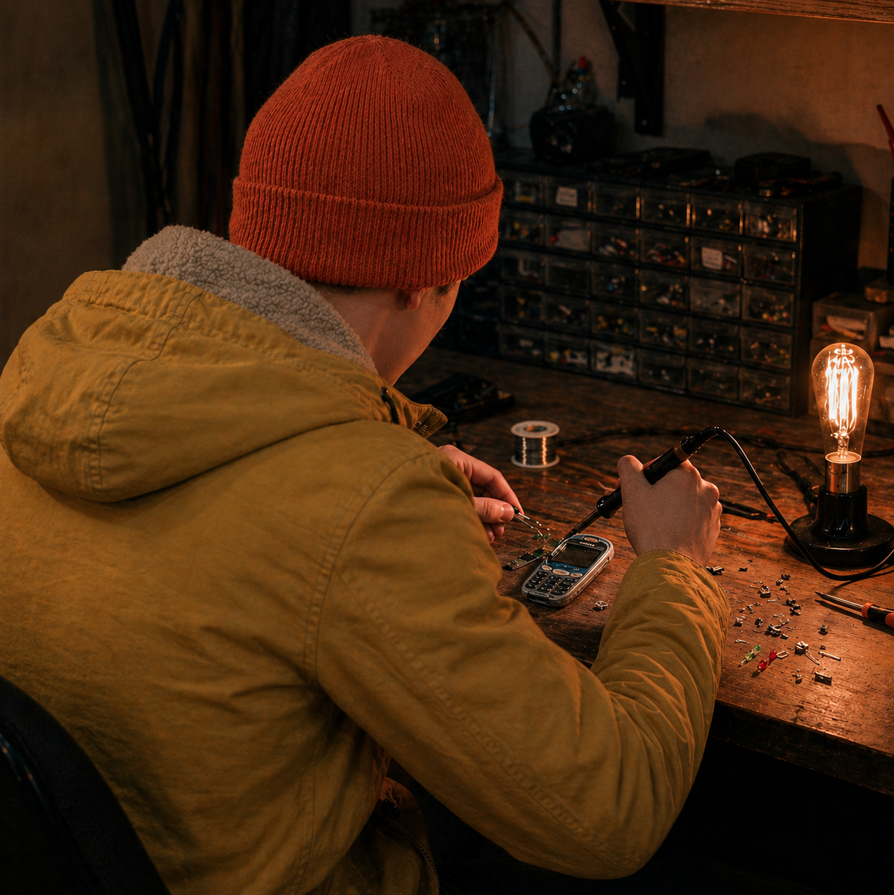
But I had not been passive about it. I had re-soldered the backlight diodes on my Siemens C55 by hand. The standard color was orange. I went with blue. That was my way of moving toward something I could already sense was coming.
He told me the future was color. In one or two years, all phones would have color displays. I thought he was being optimistic. I estimated five years. Maybe more.
He was right. I was not even close.
I have thought about that moment many times in the twenty years since. Not because I was wrong about the timeline. But because of what my hands were already doing while my head underestimated the speed.
The confusion from that April call is the same pattern. Different technology. Same perceptual stage.
When people say "AI" today, most mean the chat interface. The window you type into. The thing that answers. That is what got demonstrated, adopted, written about, put into pitch decks and strategy slides.
It is not wrong to find it useful. It is useful. But it is the lightbulb.
When electricity arrived, the lightbulb was the first thing people understood. A wire, a filament, light. You could show it at a dinner party. It made sense immediately. Nobody standing in front of it in 1880 was imagining the refrigerator, the electric motor, or the production line built around it. Those things were not visible yet.
Clients could only want what they could see.
That is not a failure of intelligence. That is the honest condition of being early.
Latvia has a useful way of thinking about electricity infrastructure.
Sadales tīkls manages the grid. Elektrum sells you the electricity. RD Veikals sells you the television set. Samsung manufactures it. Tet and Netflix deliver what runs on it. Five completely different companies, five completely different relationships with the customer.
All connected to electricity. None of them the same thing.
Society navigates this without confusion now. Because time gave each layer a name, a bill, a support number.
AI has none of those names yet.
When a company announces an AI-enabled product, that phrase carries almost no information. Which layer? Whose model? What happens when the output is wrong? Mixing up a large language model with a chat interface is like mixing up a hydroelectric station with the warmth coming off a radiator. Related. Not the same.
Nobody says: we are an innovative company because we have electricity.
That sentence is already absurd. Give it time, and the same will be true for AI. Having access to it will not be a competitive advantage. It will be the floor. The question will not be whether you have it. It will be what you built on top of it, and whether you understood which layer you were standing on.
The chat is the lightbulb. The motor has not arrived yet. Most of the stack is still invisible.
I left the desk eventually. The clouds were still moving behind the glass.
The call had been good. The client was serious. The conversation was real.
But I kept thinking about my classmate and his Samsung. About the diodes I soldered by hand, already moving toward something I could feel but not yet name. About how the future was closer than I thought, and shaped differently than I imagined.
That is where we are with AI in April 2026.
The lightbulb is on. Most of the room is still looking at it.
The interesting part starts after.