The Radius
Why Not All Happiness Travels
Two people. The same quiet ease. Everything else different.
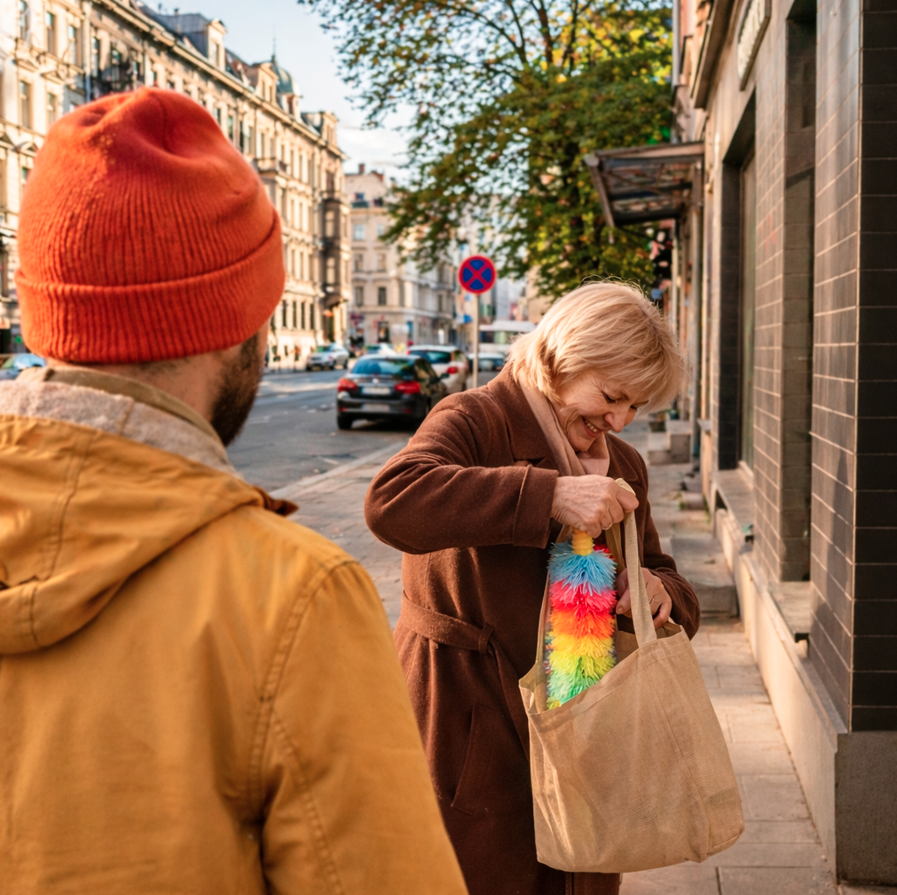
I was walking to the cafeteria for lunch when I noticed her.
A woman, somewhere between sixty and seventy, stepping out of a store. In her hands: a dust brush.
What I noticed was not the brush.
It was how she handled it.
She looked at it the way people look at something they have been thinking about for a while. Then she opened her bag and placed the brush inside. Carefully. Almost tenderly. There was a small, unhurried satisfaction in the movement. No performance. No audience. Just a woman, a brush, and a bag.
For a fraction of a second, I felt what she was feeling.
Not imagined it. Felt it.
An hour later I was driving home.
At a bus stop, a man was standing alone. Somewhere around fifty, maybe older. His eyes had that particular unfocused calm that comes after a few drinks earlier in the day. He was not going anywhere in particular. He was simply standing there, settled.
In his world, he was balanced. Comfortable with himself, comfortable with the evening, comfortable with the empty street.
And then I caught myself.
My first internal move was to label it: not real. A shortcut. A borrowed state. I held that judgment for a moment, then put it down. He was not asking to be evaluated. I was watching from a moving car. What I was calling a shortcut was, in his experience, simply how it feels.
That is where the interesting question started.
Because both people looked, in their own way, genuinely at ease. The woman with her brush. The man with his stillness. Neither was performing for anyone. Neither needed confirmation.
The feelings were probably not that different on the inside. A kind of warmth. A quiet alignment between self and world. A moment of being exactly where you are.
Same destination. Very different roads.
What separated them was not the feeling itself.
It was what the feeling was built from, and what it produces next.
The woman's happiness came from something small that fit her actual life. A specific tool for a specific need, at a price that made sense to her. The joy was proportional, and it was pointed: toward the tasks already waiting at home, toward the rooms she knew, toward a plan she already had. Her happiness had a future in it.
The man's happiness was complete in itself. Not wrong. Not judged. But contained. It did not connect to anything that was about to happen. It arrived chemically, and it would leave the same way. There was nothing downstream.
This is where the real difference lives: not in the experience of happiness, but in its radius.
Some happiness extends. It connects to work, to people, to things not yet built. It carries weight into the next day.
Some happiness stops at the person who feels it. It does not travel.
I do not think this is a moral distinction. I am not arguing that one kind of happiness deserves more respect than the other.
But it matters when you are building something, including a life, including an organization.
If the only measure is whether people feel satisfied at a given moment, the signal is almost useless. Two people can register identical internal states through completely different mechanisms, with completely different consequences.
A team comfortable because the work is going well produces different results than a team comfortable because no one is being held accountable. Both teams feel fine. The surface readings look the same.
The question is not: are people happy?
The question is: what is this happiness made of, and where does it go from here?
I kept thinking about the woman and her brush.
Not because her happiness was larger or more legitimate. But because it was accurate. It corresponded to something real in her life. She knew exactly what the brush was for. She already had plans for it.
That is the version I keep looking for in my own work. Not intensity. Not frequency. Just that: a feeling that comes from something real, and points toward something next.
It does not have to be large.
It has to be aimed.