The Reflex
and the Result It Was Trying to Prevent
The movement designed to prevent the outcome can become the movement that produces it.
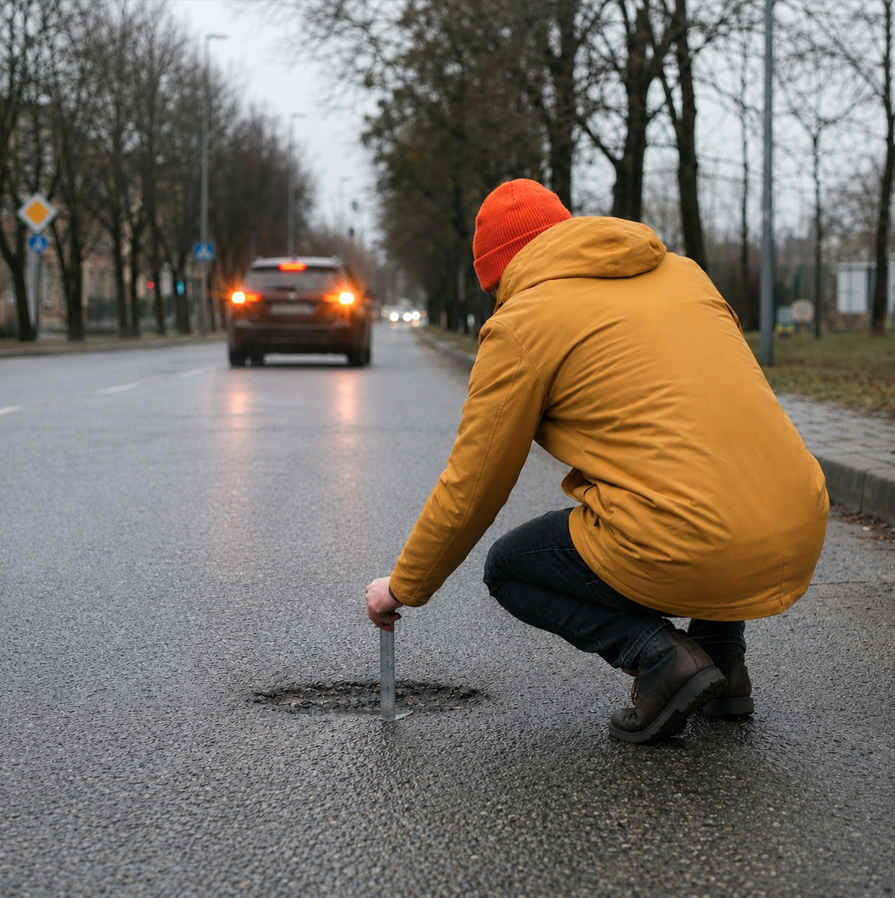
I only just left home.
The road is familiar. A right turn onto Vienības gatve. I made the turn and started returning the wheel to center. I was choosing my lane. I was building speed.
That is the moment the pothole appeared.
Not deep. Not dramatic. A regular city road defect, the kind that has been there for weeks and nobody filed anything about. I saw it at the end of the curve, right at the boundary where the turn was finishing and the straight was beginning.
My hands moved.
I did not decide to move them. By the time I registered that the pothole was there, the wheel had already jerked. The reflex had already begun. My hands were trying to protect the car from something they had seen before my thought had fully named it.
The result: half-wheel contact. A small knock. The kind of sound that is not serious but is not nothing either.
My goal had been zero contact.
I sat with that for a moment. The chain was very short: saw it, pulled, hit it. Three steps. The third step was the one I was trying to prevent. The second step is what made the third step happen.
If my hands had not moved, the trajectory might have carried me past it. I will never know. What I do know is that the movement designed to avoid the outcome became the movement that produced it.
The reflex was not wrong in its intent. Eyes spotted a hazard. Body responded to protect the machine. That is exactly what reflexes are for.
But intent does not travel forward into physics.
The wheel moved. The car moved in relation to the wheel. The pothole did not move. Half a wheel touched something it was trying not to touch.
Nobody was hurt. The car was fine. This was a small event by any measure.
But the category of the event matters more than the size.
Because the same mechanism runs at every scale.
A person hears something uncomfortable in a conversation and responds before deciding to respond. The sharp answer arrives. The relationship registers it. The intent was self-protection. The result is friction that was not there before the protection.
A manager sees a risk appear mid-transition. The team is already reorganizing, already switching from one process to another. The manager intervenes. The intervention adds a layer of control that the team now has to navigate on top of the transition they were already navigating. The risk was small. The intervention created a larger one.
A company is mid-shift. A new system is being deployed. A small exception surfaces. The protection protocol triggers. Suddenly there is a committee. There are reviews. There is documentation. The exception is now less important than the process the exception activated.
An AI model reads a sentence, flags something that looks like an error, corrects it automatically. The correction removes a rough edge that was holding a specific meaning the writer put there deliberately. The model was protecting against mistakes. It produced one.
In every case the structure is the same.
The protective movement was real. The intent was real. The result was not what the protection was for.
There is a detail that has stayed with me about the pothole.
It appeared at the boundary. Not on a straight road where I was stable and had full attention available. Not at the beginning of the turn when I was fully concentrated on the curve. Right at the edge. The turn was ending. The straight was beginning. The wheel was coming back to center. I was choosing a lane. I was starting to accelerate.
My attention was already occupied with transition.
The pothole did not arrive into a clear system. It arrived into a system already in motion between states. And the reflex had no queue to wait in. There was no gap between seeing and moving.
I think about all the moments when problems appear not in stable conditions but at the boundary. When a team is already switching from one way of working to another. When a person is already in the middle of changing something about themselves. When a system is already in a different state than the one it was designed for.
The boundary is where the pothole is most expensive.
Not because it is bigger there.
Because at the boundary, the reflex has nowhere to pause.
I drove on. The car was fine. The knock faded.
But the chain did not unfold differently just because the result was small.
Saw it. Pulled. Hit it.
That sequence does not ask whether the protection was well-intentioned.
It just records what happened.