The Twelve O'Clock
and the Thirty Seconds Between Two Systems
The same place, the same people, the same counter. A different system. The switch took thirty seconds.
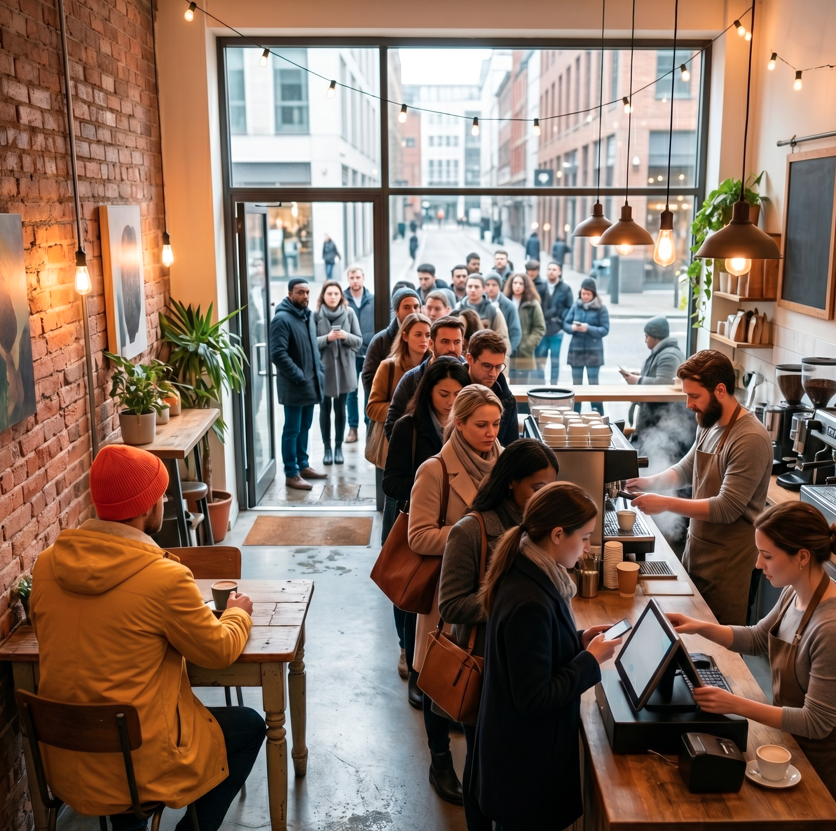
I arrived before noon. The café was almost empty. Two workers behind the counter were moving slowly, deliberately. One was arranging something near the coffee machine. The other was wiping down the preparation area. When I ordered, the person at the register looked at me. Not through me. At me. She smiled, confirmed my order, repeated it back. There was time for that.
I found a table, sat down, waited for my order. The place had a specific kind of quiet. Not empty-sad. Just between states.
Then the clock hit twelve.
I am not sure I can describe how fast it happened. Within thirty seconds, the queue reached the door. Then past the door. People were standing on the street. They had appeared in groups of two and three, all at once, as if released from somewhere nearby at the same moment. Which, of course, they were. Office lunch breaks start at noon.
I watched the workers.
The smiles disappeared. Not because something went wrong. They disappeared because there was no longer time for them. The movements changed: shorter, more exact, no pauses between steps. Nobody gave an instruction. Nobody called a meeting. The shift happened without announcement. The same people, the same counter, the same kitchen. A different system.
What I noticed: they were ready. This was not a surprise to them. They had done this before, at this exact time, every day. The preparation in the quiet morning was not downtime. It was part of the same process.
The clients adapted too, without being asked.
People standing in the queue were scanning the room. Not for the menu. For tables. They were calculating: who is almost done, which seat might open, whether to move toward a table now or risk losing it. Some of them had clearly been here before and knew the math. Others had not, but they read the room and copied the behavior. A small, spontaneous coordination system formed inside the café, with no one managing it.
This is the part that stayed with me afterward.
The café was not optimized for the average. It was built to hold two different states. Slow and fast. Sparse and packed. Individual contact and pure throughput. And the transition between them took roughly thirty seconds.
Most systems are not built this way. Most systems are built for one condition, usually the expected one, the average load, the normal day. When the peak arrives, it is treated as an exception. Something to manage, apologize for, explain. The queue becomes a problem instead of a scheduled event.
But noon is not a surprise. It arrives every day, at the same time, for the same reason. Any system that is surprised by it has chosen not to prepare.
This applies further than lunch.
A support team that is calm on Tuesday and overwhelmed on Friday after a release is operating in the same pattern. The peak was visible in advance. The system was not shaped to hold both states. A hospital emergency unit that functions differently at 3am than at 3pm has either built that into its design, or it has not, and the difference is visible when it matters most.
The question is not whether a system will face two different loads. It will. The question is whether the switch between them was designed, or whether it is just happening and people are absorbing the cost each time.
In the café, the switch was designed. Not documented, probably not written anywhere. But practiced, repeated, internalized. The workers knew when noon was coming. The system held.
Two different organizations. One place. Thirty seconds apart.