What If
It Succeeds
The protective mode does not arrive as fear. It arrives as a reasonable question.
I was in the middle of a sentence when I caught it.
My CEO was pitching a new direction. Fast, energized, the kind of energy where ideas arrive before the last one lands. I was following him, nodding, and then I started: "What if..."
His face changed. Not dramatically. He just slowed. Prepared. I could see him assembling the arguments he had probably used before, the ones I already knew, the ones I did not need to hear again.
I stopped.
Smiled.
Said I was all in.
That same morning I had been in another conversation. A subordinate of mine, talking about hiring, about moving faster, about building capacity. Capable person. Good instincts. But somewhere in the middle of it, the conversation shifted. Not to no. Just to: what if there's no load. What if it doesn't work. What if we can't handle it. A hundred versions of the same hesitation, none of them wrong exactly, all of them arriving before we had taken a single step.
I told him what someone once told me. Millionaires don't solve future problems. They solve problems when they actually appear. Let's find the person first. The problems will come when they come.
He agreed. We moved on.
Four hours later I was doing the same thing he had been doing.
That is the part that stayed with me.
Not that my subordinate was cautious. Not that my CEO was optimistic. Both of those are true and both make sense given who they are and what they carry.
What stayed with me was the moment I caught the switch happening inside me. Mid-sentence. The question was already coming out of my mouth and somewhere behind it I recognized the pattern. The same one I had redirected that morning. The same one dressed in reasonable language, arriving before any real evidence, protecting me from a problem that did not yet exist.
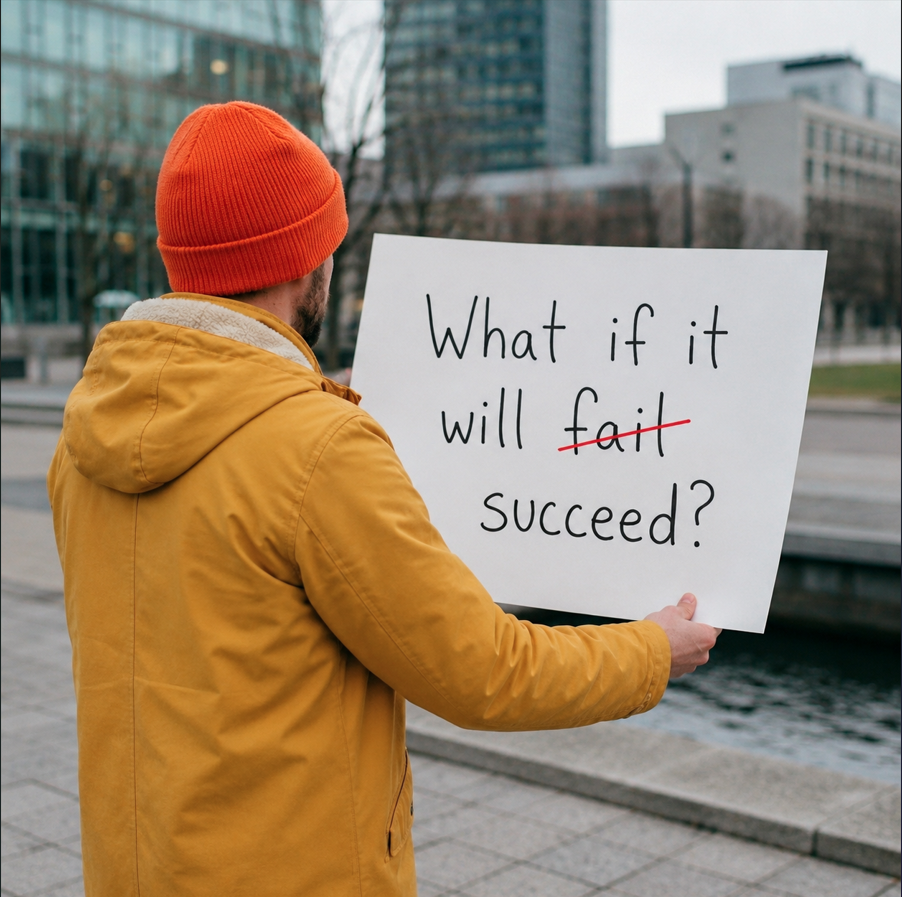
There is a mode that asks: what if this fails.
There is a mode that asks: what if this succeeds.
They are not personality types. They are not signs of weakness or strength. They are modes. And they can arrive in the same person on the same day depending on which direction the pressure is coming from.
When I am responsible for something below me, I watch for what could go wrong. I have seen what unmanaged risk looks like. I have cleaned it up.
When I am responsible for something above me, I am expected to move. To absorb the direction. To convert possibility into plan.
The tension between those two positions is real. The mistake is not feeling it. The mistake is when the protective mode activates too early. Before the first step. Before the first test. Before any actual evidence arrives. When you are already living inside a future failure that has not happened yet, running the post-mortem on a project that has not started.
My four-year-old son has not learned this yet.
When I test him on his requests, say: but what if that fails, he answers without hesitation.
But what if it succeeds.
He does not flip the question. He never accepted the fearful version as the default. The protective mode has not installed yet.
I do not think the answer is to remove the protective mode. It exists for reasons. It has saved me from real mistakes.
But the sequence matters more than the mode.
Direction first.
First step next.
Problems when they arrive.
Not before.
That afternoon, when I caught the "what if" coming out of my mouth, I felt something shift. Not resolve. Not discipline. Something closer to accountability. The question had already started. I could see where it was going. I recognized what it would cost.
So I smiled.
And said I was all in.